

Building a career with the wild
Pristine jungles are usually off-limits to travelers but volunteers who have a genuine passion for wildlife conservation can find themselves in the most secluded regions on earth. We put the spotlight on the Great Orangutan Project where volunteers work on the survival of Asia’s great ape, take boat safaris to wildlife reserves and camp with the headhunters of Borneo.
Perhaps, you have heard of stories of a corporate executive selling all she has to travel the world, or a multimillionaire spending all his money just to feel like Indiana Jones. But have you ever heard of people who splurge thousands of dollars just to measure flamingoes’ legs, feed orangutans, or scrub the walls of a pigpen? In Malaysia, many students and professionals from all over the world are taking a time off to pursue a different path: build a career through working with endangered animals.
Project: Orangutan
For many years, the highlight of a forest trip to Malaysia was to see “elusive” animals such as the orangutan, Asia’s only native great ape found in Malaysia and Indonesia. More than half (59%) of the country is cloaked in lush vegetation and untouched rainforests, however it's hard to spot the orangutans that once inhabited the place. These brown-haired apes used to play by the thousands in the forests between Padas River in Sabah and Rejang River in Sarawak, but today, orangutans are rarely seen by visitors, if seen at all. The biggest remaining population is in the jungle surrounding Sabangau River, but even this environment is at risk. Scientists, in fact, have classified the orangutans as critically endangered primates. If deforestation, slash-and-burn farming, logging, hunting, and illegal pet trade continue, scientists fear that orangutans would face a real doomsday by 2012.
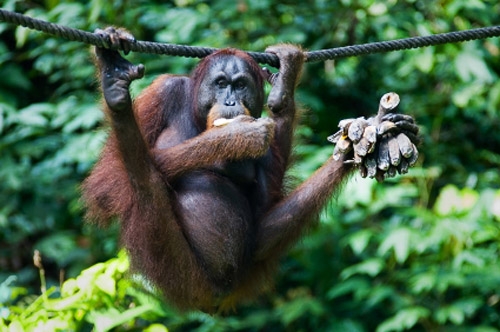
Orangutan in Sepilok Nature Reserve in Sabah, Malaysian Borneo
Coming to the orangutans’ rescue, Sarawak’s forestry department recently invited a group of multinational conservationists to form the Great Orangutan Project (GOP), a series of conservation programs designed to involve volunteers in saving the orangutan while educating the local communities on alternative livelihoods that would not threaten the primates or the environment. Volunteering with the likes of GOP would enable travelers to hit two birds with one stone: conservation and adventure in one eco-tour that includes “backstage passes” to an orangutan rehabilitation center at Matang; boat safaris to wildlife reserves; and rainforest camping with the legendary headhunters of Borneo.
Educating homo sapiens
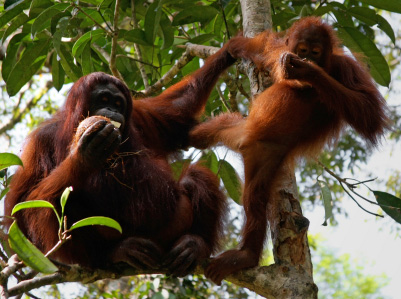 Although ultimately aimed at increasing the population of orangutans, GOP also hopes to improve the socio-economic status of the indigenous human communities living alongside the primates. The program’s leaders and volunteers believe that their efforts would not succeed unless they engage the local people in wildlife conservation and management, that is, to protect and nurture animals rather than hunt and kill them. “We do not want to stay forever,” says Guillaume Feldman, GOP’s director for conservation. “We would like to provide the local government, host communities, and the local partners with the knowledge, support, and training necessary to run conservation projects themselves. Once we have everything, we can to create a sustainable future for both the wildlife and local communities, the end result would be our ultimate removal as facilitators.”
By addressing the locals’ needs and through helping them understand their relationship with Mother Nature, GOP wishes to reduce poverty and illegal forest practices such as slash-and-burn farming and pet trade. The program’s volunteers currently work to achieve such goals through providing locals with work opportunities in orangutan preservation, and via promoting responsible volunteering and tourism as means for gaining sustainable income while spreading the value of orangutan conservation.
Volunteer packages: have your pick
Travelers can be involved in the program that is taking place in Malaysia and Borneo (Sabah and Sarawak), either by committing on a long-term project, or by signing up on a 13 to 14-day holiday eco-tour.
A holiday eco-tour usually includes short-term rescue and rehabilitation activities such as observing orangutans and other endangered species in a reforestation project in Kinabatangan; feeding baby orangutans at rehabilitation centers like Sepilok Orangutan Sanctuary in Sabah; and camping as well as basket-weaving with rainforest tribes such as the Batang Ai and the Iban, the descendants of Borneo’s notorious headhunters.
Participation in a long-term project usually lasts from two weeks to a month, depending on the volunteer’s choice of tasks. It can include working in a Malaysian zoo (like cleaning sun bears’ cages), assisting an orangutan deliver a “miracle” baby in a sanctuary, and helping the research team by recording the orangutans’ movements and behaviors.
Some volunteers go as far as opting to do a “volunteer expedition” or seeing through each stage of an orangutan’s life cycle, as if it is their baby—from the orangutan’s birth in Matang Wildlife Center, to its growth in Semonggoh Nature Reserve, and to its release in the rainforests of Batang Ai National Park. Those who wish to go on a sabbatical while conserving orangutans can enter the world of orangutans through renting eco-lodges in Borneo, where they will live for a year to plant trees, immerse with the locals, and live and play with over a thousand primates of all ages and sizes.
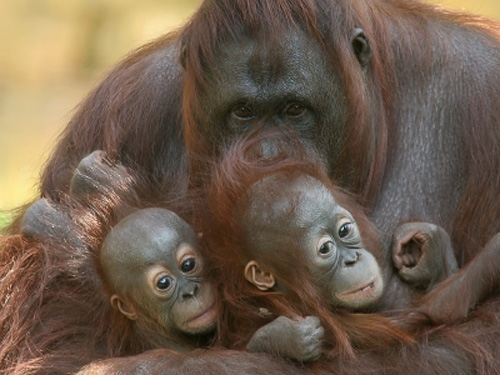
The tours cost from £650 (USD 1,064.31) to £1050 (USD 1,719.28) per person. So far, the program has gathered a total of £300,000 (about USD 5 million) in funds, which will be spent on the 250 orangutans that are on their care. “March 2009 was full of fun. All the volunteers got along very well and worked hard on each task given,” says Malaysian volunteer Ili Dayana Sudirman, who, apart from saving the orangutans, also took part in other conservation activities such as transferring sun bears from one zoo to another and measuring flamingoes’ legs to find out if the legs’ length is influenced by gender.
Why save the orangutans?
According to Robert Deaner and his fellow psychologists, orangutans are the world’s most intelligent species other than humans. Such primates are also very close to humans when it comes to looks and behavior. As such, doctors and scientists can understand a great deal about human evolution, character patterns, and ailments by studying orangutans. Feldman agrees, saying that "flagship endangered species such as orangutans are used to explain the complex interrelationship between humans and the environment,” which is why, orangutans should be conserved.
“Travelers who seek meaningful experiences are provided with opportunities to join one of our flagship conservation programs such as the GOP,” says Feldman, adding that programs like GOP do not only put a new twist into traveling, but also help travelers for their own self-improvement and help increase employability especially during economic hard times.
Feldman, and traveler-volunteers like him, appeal for everyone to try taking a gap year or a career break to build a vocation geared towards working with endangered species. “Let us give orangutans a fighting chance to survive the wild,” he advises.

The latest features
Summer Destination to Avoid: Gulf of Mexico
 EPA is failing to do their job monitoring the air and reporting factual data. The people need to be made aware that their lives and long term livelihood are at stake because of the air quality in Gulf of Mexico.
How to Avoid Traveling Troubles
 Traveling to a certain destination might not become memorable if there are too many troubles along the way. Remember that even the best trips are usually not trouble-free. Follow these tips that help lessen the hassles.
Unique Toys from Japan
 Japan is known for its fascinating, and sometimes, eccentric culture. From anime, karaoke, to advanced technology, the Land of the Rising Sun always has something unique to offer.
Exploring California's Venice Beach
 Travelers who are after the sunny side of Southern California can visit the beautifully eccentric Venice Beach, also known as Arnold Schwarzenegger’s Muscle Beach, home to Hollywood royalties Julia Roberts, Kate Beckinsale, and Nicolas Cage.
When Mother Nature wields terror
 Some places are made dangerous by the conflicts brought about by humans. But in these towns and cities—most of them heavily populated—it is Mother Nature which is always on the verge of wrath, wrecking havoc of unimaginable proportions.
Slaughter of dolphins comes to cinemas
 Ric O’Barry once captured and trained dolphins in amusement parks and made the character Flipper world famous. Now, he is the animals’ unlikely champion, exposing the savage ways they are hunted in a small town in Japan. This time, he wants the dolphins swim free.
The new Bollywood fever
 As one of the major film production centers in the world, Bollywood churns out about 1,0000 movies, most of which cater to India’s masses. They precariously enact their lives through the characters, escaping to a world where everything in the end gets resolved in song and dance.
Finding Haiti Amid the Rubbles
 Weeks after the earthquake that rocked Haiti, rescuers are still finding survivors amid the rubbles. It seems that the hardy spirit of Haitians is still alive, inherited from their ancestors who led the only successful slave revolt in history.

