

Pull the plug on Panda?
When TV host and naturalist Chris Packham said that pandas should go extinct, a furor erupted in the cyberspace. People either disagreed with him or took his position. We examine the uproar and puts the spotlight on the giant panda which has become the symbol for species conservation worldwide
BBC host and naturalist Chris Packham ruffled the feathers of conservationists and animal lovers when he declared in an interview with Radio Times magazine that pandas should be allowed to go extinct. “Here's a species that, of its own accord, has gone down an evolutionary cul-de-sac,” he said. “I reckon we should pull the plug. Let them go, with a degree of dignity.”
Rather than pouring millions of dollars into panda conservation, Packham opined that the funds should be diverted in protecting other animals that are more tenacious and likely to survive. "It's not a strong species,” he said of the pandas. "Unfortunately it's big and cute and it's a symbol of the WWF (Worldwide Fund for Nature)."
Records show that a zoo in the United States, which keeps giant pandas need to spend US$ 2.6 million per year for the animals’ welfare. A birth of a cub or two (most pandas give birth to twins) can easily double the investment, which doesn’t include the US$ 1 million that the zoo has to pay to the Chinese government to support the pandas still living in the wild.
In an interview with the National Geographic, David Wildt, head of the National Zoo's reproductive sciences program admits that “nobody would ever commit this kind of money to any other species.”

Too cute to let go extinct?
Is it worth it?
In the New Zealand Herald, Kerre Woodham thinks that the only reason why pandas are still kept alive is because they are cute and cuddly. “The only thing pandas have got going for them is that they are desperately cute,” she says.
But it seems that more than cuteness is going for the pandas that has made them survived this far. First, the panda is the national symbol of China, an emerging superpower, and it’s highly unlikely that the government will allow a national treasure to perish. By making the panda as its logo, the WWF asserts the panda’s position as the symbol for wildlife conservation.
No other animal too inspires an international cooperation concerning endangered animals more than the panda, as evident in the US-China relation. Currently, about 11 zoos in the United States host pandas, which are then bred in captivity and sometimes returned to their natural habitat.
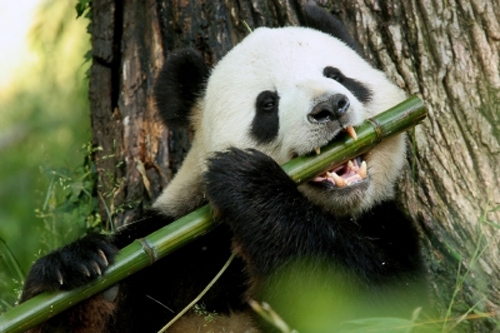
Does anyone has a photo of a panda does anything else but eating?
Pandas will probably go extinct anyway
Critics who say that breeding pandas is a lost cause are mistaken, scientists assert. For more than half a million years, pandas have managed to survive, that is, until humans have started encroaching, fragmenting and decimating their environments. In her lifetime, a wild female panda will be able to add five to six cubs to the population.
“The reproduction capacity of normal wild pandas is very strong, thanks to a better environment and more choices for food and mating partners,” Zhang Zhihe, chief of the Chendgu Research Base of Giant Panda Breeding in Sichuan province, said to China Daily.
Though all species on the planet are fated to become extinct, experts are alarmed with the speed by which some of them disappear. The speed is estimated to be about 100 to 1,000 times higher than the expected natural cycle, a phenomenon they refer to as the 6th wave of extinction. Species conservation, experts believe, should be a vital part on how we conduct ourselves as stewards of the planet.
Strides in saving the pandas
Pandas may seem high-maintenance animals but efforts in protecting them have paid off. WWF reports that over 50 nature reserves in the panda habitat have been established compared to the 13 twenty years ago. “This includes over 500,000 ha of new and expanded nature reserves in the Minshan Mountains and 8 new nature reserves and 5 green corridors have been created in the Qinling Mountains,” the report says.
In an apparent attempt to stave off the controversy, Packham reflected on his statements and apologized to those who have been offended by his comments. “I really upturned the apple cart with what I said and I'm sorry I upset people. But I am glad it has raised a debate and that was always my intention. I don't hate pandas, I love cuddly animals. I love all animals,” he said in an interview with the Mirror.
Packham’s pessimism toward the fate of the pandas may just what conservationists need to further strengthen their resolve in protecting and making pandas thrive. Future generations also deserve to see pandas as much as we do. The only good thing that can come out of this is for conservationists to prove Packham wrong.

The latest features
Summer Destination to Avoid: Gulf of Mexico
 EPA is failing to do their job monitoring the air and reporting factual data. The people need to be made aware that their lives and long term livelihood are at stake because of the air quality in Gulf of Mexico.
How to Avoid Traveling Troubles
 Traveling to a certain destination might not become memorable if there are too many troubles along the way. Remember that even the best trips are usually not trouble-free. Follow these tips that help lessen the hassles.
Unique Toys from Japan
 Japan is known for its fascinating, and sometimes, eccentric culture. From anime, karaoke, to advanced technology, the Land of the Rising Sun always has something unique to offer.
Exploring California's Venice Beach
 Travelers who are after the sunny side of Southern California can visit the beautifully eccentric Venice Beach, also known as Arnold Schwarzenegger’s Muscle Beach, home to Hollywood royalties Julia Roberts, Kate Beckinsale, and Nicolas Cage.
When Mother Nature wields terror
 Some places are made dangerous by the conflicts brought about by humans. But in these towns and cities—most of them heavily populated—it is Mother Nature which is always on the verge of wrath, wrecking havoc of unimaginable proportions.
Slaughter of dolphins comes to cinemas
 Ric O’Barry once captured and trained dolphins in amusement parks and made the character Flipper world famous. Now, he is the animals’ unlikely champion, exposing the savage ways they are hunted in a small town in Japan. This time, he wants the dolphins swim free.
The new Bollywood fever
 As one of the major film production centers in the world, Bollywood churns out about 1,0000 movies, most of which cater to India’s masses. They precariously enact their lives through the characters, escaping to a world where everything in the end gets resolved in song and dance.
Finding Haiti Amid the Rubbles
 Weeks after the earthquake that rocked Haiti, rescuers are still finding survivors amid the rubbles. It seems that the hardy spirit of Haitians is still alive, inherited from their ancestors who led the only successful slave revolt in history.

